
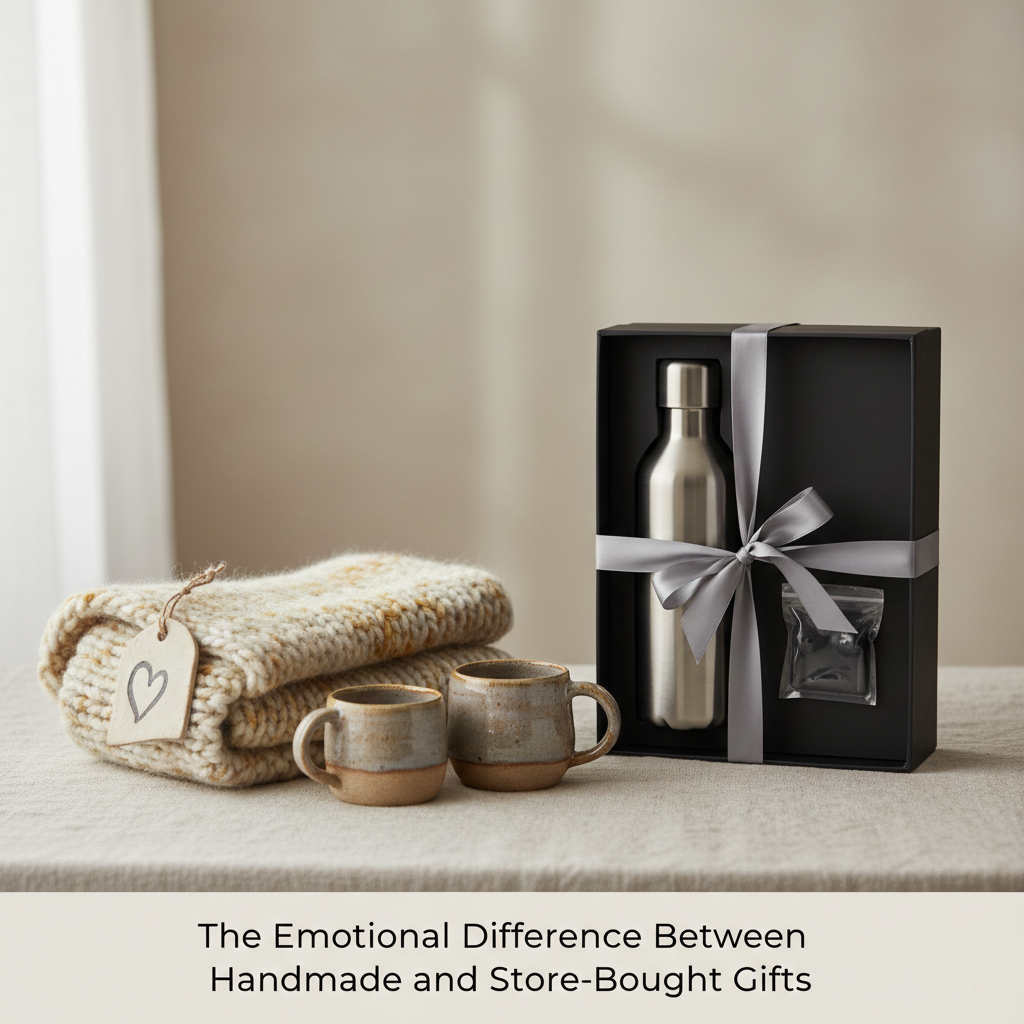
Why some gifts feel warm—and others just feel finished
Most gifts are opened, admired, and thanked for.
A smaller number are felt.
You can usually tell the difference immediately—not because one costs more, but because one carries emotional weight. It lingers. It feels closer. It lands in the body, not just the hands.
That difference is not accidental. It has very little to do with aesthetics or price, and almost everything to do with how meaning travels through objects.
Handmade and store-bought gifts don’t just differ in how they’re made. They differ in how they communicate.
Gifts are emotional signals, whether we intend them to be or not
Every gift sends a message. Even when we don’t articulate it, the recipient receives something beyond the object itself.
A store-bought gift often communicates:
- Reliability
- Convenience
- Social appropriateness
- “I fulfilled the expectation”
A handmade gift tends to communicate:
- Attention
- Intention
- Specificity
- “I thought about you”
Neither message is inherently bad. But they are not emotionally equivalent.
The emotional difference between handmade and store-bought gifts lies in what they signal about effort, time, and care—and how deeply those signals register.
Store-bought gifts excel at solving problems
Store-bought gifts are efficient. They are designed to reduce friction.
They help us:
- Meet deadlines
- Avoid awkwardness
- Satisfy social norms
- Check the “gift” box
There’s a reason we rely on them, especially when we’re busy, stressed, or unsure. They’re predictable. They work.
But emotional resonance is rarely built through efficiency alone.
When a gift is clearly optimized for convenience, the recipient often understands—consciously or not—that the gift solved a situation, not a relationship.
That doesn’t make it meaningless. It just makes it emotionally lighter.
Handmade gifts carry traces of human presence
Handmade gifts feel different because they contain evidence of a person.
That evidence might be visible—brush strokes, texture, asymmetry, handwriting—or it might be implied, through customization or narrative. Either way, the recipient senses that a human being was involved beyond the moment of purchase.
This matters emotionally because we are wired to respond to signs of human effort.
We associate effort with care.
We associate care with value.
Even when we can’t explain it, we feel the difference.
Imperfection is part of the emotional appeal
One of the quiet truths about handmade items is that they’re rarely perfect. And that imperfection often enhances their emotional impact rather than diminishing it.
Perfection suggests distance.
Imperfection suggests touch.
A handmade gift doesn’t pretend to be universal or flawless. It accepts its specificity. And that specificity mirrors how relationships actually work—uneven, contextual, personal.
Store-bought gifts often aim to offend no one. Handmade gifts dare to be for someone.
Effort is not invisible—it’s intuitive
People don’t need to be told that a gift took effort. They feel it.
Effort shows up in:
- Personalization
- Thoughtful alignment with taste or values
- Narrative (“This reminded me of you because…”)
- The sense that this gift couldn’t have been grabbed in five minutes
Handmade gifts tend to accumulate effort naturally, simply because they take longer to exist. Even when purchased rather than made, they reflect someone else’s time and skill—and your decision to choose that path.
That layered effort compounds emotionally.
Why handmade gifts often feel safer emotionally
This may seem counterintuitive, but handmade gifts often feel less risky emotionally than store-bought ones.
Why?
Because they shift the focus away from performance and toward intention.
A store-bought gift can feel like it’s being evaluated:
- Is it good enough?
- Is it expensive enough?
- Is it the “right” brand?
A handmade gift invites a different response:
- Someone tried
- Someone cared
- Someone chose meaning over optimization
The emotional stakes change. The gift isn’t auditioning. It’s offering.
The role of story in emotional attachment
One of the biggest emotional advantages handmade gifts have over store-bought ones is story density.
A store-bought item usually enters a person’s life without a backstory. A handmade gift almost always arrives with one—explicit or implied.
Even a simple sentence like:
“This was made by an independent creator,”
or
“This was customized specifically for you,”
adds narrative weight.
Humans attach emotionally to stories far more easily than to objects. When a gift comes with context, it becomes memorable. It gains emotional traction.
Emotional timing matters—and handmade gifts meet it differently
There are moments in life when people are especially sensitive to the emotional quality of gifts:
- After loss
- During financial stress
- At major transitions
- In periods of burnout or change
In these moments, people tend to value presence over polish.
Handmade gifts often meet that need better than store-bought ones because they feel slower, gentler, and more human. They don’t overwhelm. They don’t perform. They simply arrive.
That emotional timing can make even a small handmade item feel profound.
Supporting creators adds a layer of shared values
There’s another emotional difference that matters increasingly: values alignment.
When you choose a handmade gift, you’re often choosing to support:
- Independent creators
- Creative labor
- Craftsmanship
- Small-scale production
For many recipients, knowing that a gift supports a real person rather than a faceless system adds emotional satisfaction. The gift feels cleaner. More intentional. More aligned.
That alignment doesn’t need to be explained to be felt.
Handmade gifts don’t compete—they connect
Store-bought gifts often exist in a comparative landscape:
- Bigger than last year
- Better than someone else’s
- Newer, trendier, more impressive
Handmade gifts operate outside that economy.
They don’t try to win.
They try to connect.
That shift—from comparison to connection—is what gives handmade gifts their emotional depth.
Remembering how a gift made us feel
When people look back on gifts they’ve received, they rarely remember specifications. They remember sensations.
How it made them feel seen.
How it showed effort.
How it arrived at the right moment.
Handmade gifts are remembered not because they were perfect, but because they were personal.
They didn’t just occupy space. They held meaning.
Choosing emotional weight over emotional noise
In a world saturated with products, the emotional difference between handmade and store-bought gifts becomes clearer with time.
Store-bought gifts often create a moment.
Handmade gifts often create a memory.
Neither is wrong. But when the goal is emotional connection rather than obligation, handmade gifts tend to speak more clearly—and linger longer.
They remind us that the most meaningful gestures are rarely optimized.
They are chosen.
If this distinction between handmade and store-bought gifts resonates with you, you may want to explore What This Gift Really Says —a series examining the emotional language behind the presents we give and receive.




Add comment