
The difference isn’t subtle—and it isn’t imaginary
There’s a moment that happens when someone opens a gift and pauses. Not the polite pause—the real one. The kind where they stop smiling for a second because something landed deeper than expected. That moment almost never comes from something mass-produced.
It comes from something handmade.
Not because handmade items are automatically better or more beautiful, but because they carry something factory-made gifts almost always lack: human presence. Evidence of a person. Proof that time, attention, and intention were involved.
In a culture built around speed, scale, and convenience, handmade gifts stand out precisely because they resist all three.
This article isn’t about nostalgia or romanticizing the past. It’s about understanding why handmade gifts feel more personal—and why, when we’re trying to express real care, they often succeed where mass-produced gifts fall short.
We don’t just give objects—we give meaning
When you give a gift, you’re not only offering an item. You’re sending a message.
Sometimes that message is simple: I remembered.
Sometimes it’s layered: I know you.
Sometimes it’s vulnerable: You matter to me.
Mass-produced gifts are designed to be broadly acceptable. Handmade gifts are designed—intentionally or not—to be specific. And specificity is where meaning lives.
A handmade gift tells the recipient:
- Someone chose this deliberately
- Someone considered who you are
- Someone valued effort over efficiency
That message registers emotionally, even if the recipient can’t articulate why the gift feels different.
The psychology behind why handmade feels closer
There’s a reason handmade gifts feel warmer, even when they’re imperfect.
Human brains are remarkably good at detecting signs of effort. When we notice uneven stitches, brush strokes, slight variations in texture, or personalized details, we subconsciously register human labor.
That matters because effort is one of the strongest signals of care.
A perfectly identical product pulled from a shelf communicates reliability.
A slightly imperfect, handmade object communicates investment.
We don’t interpret that investment intellectually—we feel it.
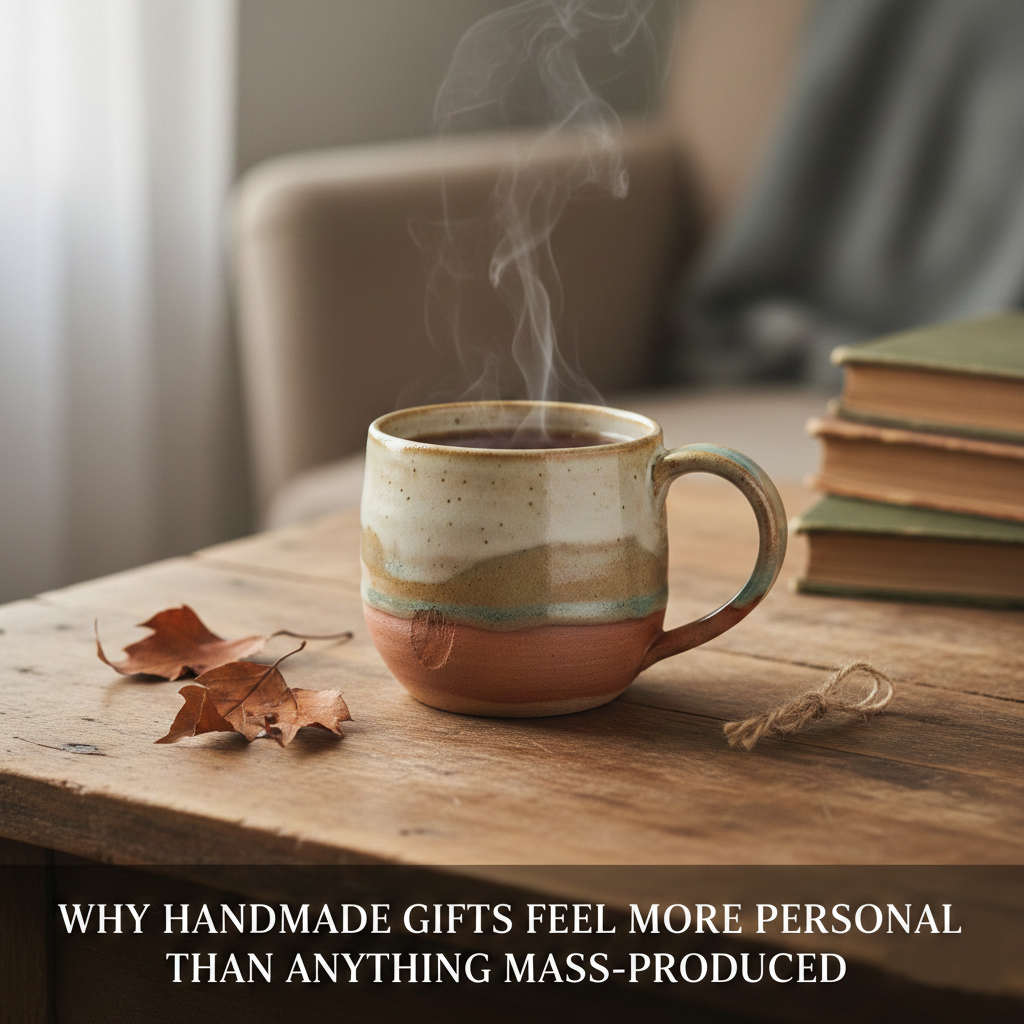
This is why a handmade mug can feel more meaningful than a designer one, and why a custom illustration can outshine a luxury print. The value isn’t in polish. It’s in presence.
Mass production optimizes for sameness—handmade celebrates difference
Mass production exists to eliminate variation. That’s its strength.
Handmade work, by contrast, almost always contains variation. No two pieces are exactly alike. And while that might seem like a flaw in other contexts, in gifting, it’s an advantage.
When you give someone something handmade, you’re implicitly saying:
“This wasn’t made for everyone. It was made for someone.”
That distinction matters deeply in relationships.
We want to feel irreplaceable. We want to feel seen as individuals, not as demographic categories. Handmade gifts align naturally with that desire because they aren’t designed for the lowest common denominator—they’re shaped by individual hands, decisions, and styles.
Time is the invisible ingredient
One of the most undervalued aspects of handmade gifts is time.
Time spent learning a craft
Time spent creating
Time spent adjusting, fixing, refining
Time spent thinking about the end recipient
That time doesn’t disappear when the gift is finished. It’s embedded in the object.
Even when you purchase a handmade item rather than making it yourself, you’re still giving something that contains time—just not yours alone. You’re offering the recipient an object that took longer to exist, that wasn’t rushed into the world.
In a fast-consumption culture, time itself becomes part of the gift.
Handmade gifts carry stories—whether we hear them or not
Every handmade item has a backstory, even if it’s never told out loud.
Someone learned a skill.
Someone practiced and failed.
Someone developed a style.
Someone chose materials.
Someone made decisions you’ll never see.
When you give a handmade gift, you’re giving an object with a past, not just a product with a SKU.
And when that story is shared—when you can say, “This was made by an independent creator,” or “This was crafted specifically with this detail in mind”—the emotional weight increases.
The gift stops being transactional and becomes narrative.
Personalization isn’t a feature—it’s a form of attention
One of the reasons handmade gifts feel more personal is that they often allow for personalization. Names, dates, colors, symbols, inside references—details that wouldn’t make sense at scale suddenly become the point.
Personalization does something powerful: it collapses emotional distance.
A gift that includes a private reference or tailored detail sends a clear signal:
“This exists because of you.”
That’s not something mass production is built to do well. It’s something individual makers excel at.
And importantly, personalization doesn’t have to be elaborate. Sometimes it’s as simple as choosing a piece that aligns with someone’s taste, values, or habits in a way a generic gift never could.
Why handmade gifts feel especially powerful during hard seasons
During difficult times—grief, financial stress, transitions, uncertainty—people often become less impressed by things and more sensitive to meaning.
This is where handmade gifts shine.
When life feels fragile, a gift that reflects care, patience, and humanity lands more deeply than something expensive but impersonal. It feels grounding. It reassures.
A handmade item says:
“Someone took time when time felt scarce.”
That message can be quietly profound.
Supporting independent creators adds another emotional layer
There’s also an increasingly important dimension to handmade gifting: values alignment.
When you choose a handmade gift, especially from an independent creator, you’re not just buying an object—you’re supporting a person’s work, skill, and livelihood.
For many gift-givers, that matters.
It adds a layer of integrity to the gesture:
- You chose craftsmanship over convenience
- You chose creativity over mass sameness
- You chose a human ecosystem over an anonymous supply chain
That intention doesn’t go unnoticed—by recipients or by ourselves.
Handmade doesn’t mean extravagant—it means intentional
There’s a common misconception that handmade gifts are inherently expensive or indulgent. In reality, many handmade items are modest in price but rich in meaning.
What distinguishes them isn’t cost—it’s intentionality.
A small, thoughtfully chosen handmade gift often feels more generous than something larger bought quickly and without reflection. The generosity is in the thought, not the scale.
This is especially important for people navigating budget constraints. Handmade gifting allows you to give something that feels full, even when resources are limited.
Why we remember these gifts longer
Ask people about the gifts they remember most, and rarely will they describe the most expensive ones. They talk about:
- The note that came with it
- The way it reflected who they were at the time
- The feeling of being understood
- The sense that someone tried
Handmade gifts tend to stay with us because they attach themselves to memory, not just utility.
They age with us.
They collect associations.
They become reminders—not just possessions.
Choosing handmade is choosing connection
At its core, the reason handmade gifts feel more personal is simple:
They are made—or chosen—with connection in mind.
They resist anonymity.
They resist speed for speed’s sake.
They resist the idea that meaning can be mass-produced.
In a world increasingly optimized for efficiency, handmade gifts quietly insist on something else: attention, care, and human presence.
And that insistence is what makes them unforgettable.




Add comment