
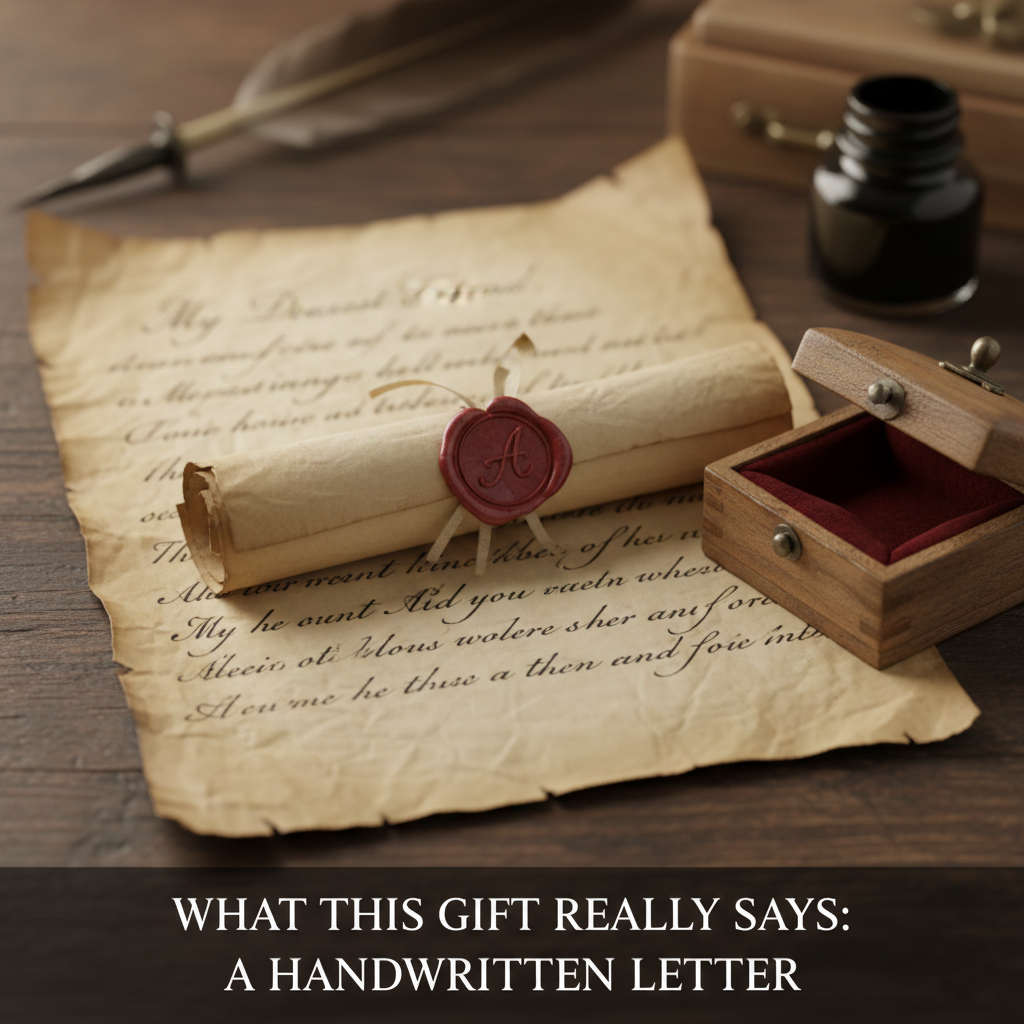
A handwritten letter is a dangerous gift.
Not because it’s risky.
Because it’s honest.
In a world full of instant messages and quick reactions, a handwritten letter says something most gifts don’t dare to say:
“I slowed down for you.”
And that can land beautifully — or intensely — depending on the relationship.
The Surface Meaning: Sentiment
On the surface, a handwritten letter says:
- I care.
- I appreciate you.
- I wanted this to feel personal.
It’s inexpensive. It’s simple. It doesn’t rely on trends or algorithms. And yet it often feels more vulnerable than something expensive.
Because a letter isn’t about the object.
It’s about exposure.
The Emotional Subtext: Presence
A handwritten letter communicates three powerful things:
1. Time
You had to sit. Think. Write. Rewrite.
2. Intention
You couldn’t autopilot it.
3. Emotional Risk
You chose to say something real.
That’s why letters feel intimate even in friendships. They carry your voice in a way typed words don’t. The paper becomes proof that you were there — fully.
This is the opposite of what we explored in What This Gift Really Says: A Candle, where the object sets a mood.
A letter is the mood.
Why Letters Sometimes Feel “Too Much”
Here’s the part people don’t talk about.
A handwritten letter can overwhelm if:
- The relationship isn’t emotionally close
- The message carries unresolved tension
- The tone feels heavier than the occasion
Because letters amplify emotion. They don’t dilute it.
A casual friendship letter that reads like a farewell speech? Intense.
A romantic letter too early in dating? Pressure.
An apology letter disguised as a birthday note? Complicated.
The power of a letter is clarity.
But clarity has weight.
How to Give a Handwritten Letter Well
The goal isn’t poetic perfection.
It’s emotional alignment.
Match depth to relationship
- Close friend → appreciation and shared memories
- Partner → specificity and vulnerability
- Parent → gratitude and recognition
- Child → affirmation and belief
Don’t write the letter you wish you could send.
Write the one the relationship can hold.
Presentation Quietly Changes the Message
Even though the words matter most, the physical details still communicate something.
A rushed sheet torn from a notebook says:
“This mattered, but I didn’t prepare.”
A thoughtfully chosen card or quality stationery says:
“This deserved space.”
You don’t need extravagance — just care.
If you’re looking for simple but elevated options, curated stationery sets on Amazon can help the letter feel intentional without being dramatic. Minimal linen paper, deckled edges, or thick cotton stock subtly elevate the emotional tone.
If you want something more personalized — especially for anniversaries or milestone moments — custom name or date-embossed stationery from Etsy can add a layer of permanence without changing your words.
The paper doesn’t make the message meaningful.
But it signals that the message mattered.
When a Letter Is the Perfect Gift
A handwritten letter is perfect when:
- You want to say something that shouldn’t be rushed
- You’re marking a transition (graduation, move, birthday, anniversary)
- You want to offer reassurance that lasts longer than a moment
- Money feels secondary to meaning
It’s also powerful when paired with a small symbolic object — a book, a framed photo, even a candle — because the letter explains the gift instead of the gift carrying the weight alone.
In fact, some of the most powerful gifts cost almost nothing. If you resonate with that, you’ll love our upcoming piece in this series: What This Gift Really Says: No Gift at All.
The Quiet Truth About Letter Writing
A handwritten letter says:
“I see you.”
“I remember.”
“I’m willing to say this clearly.”
It’s one of the few gifts that can’t be outsourced.
You can’t click it into existence.
You can’t automate sincerity.
And maybe that’s why it still feels rare.
In a culture that optimizes everything, choosing to write by hand is a small rebellion. A soft one. A steady one.
It says:
You were worth slowing down for.




Add comment