
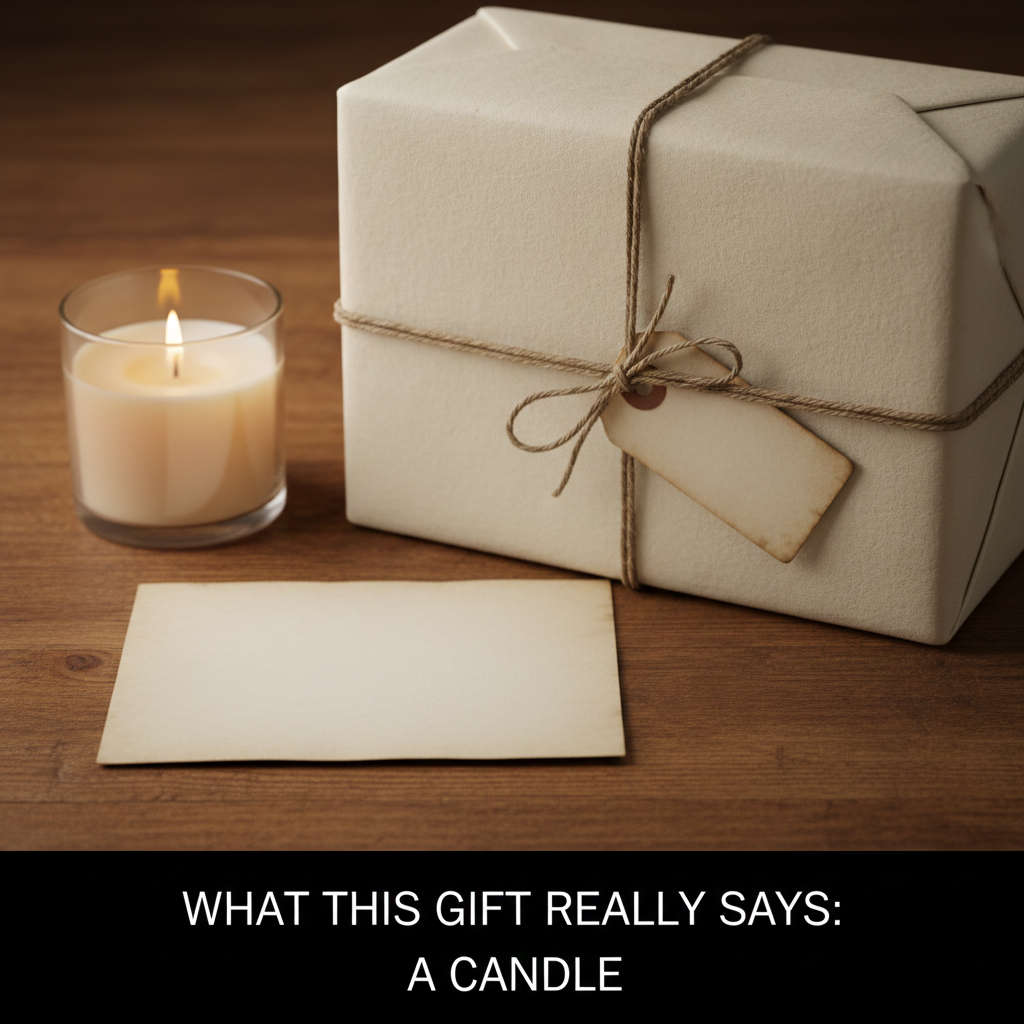
A candle is one of the most misunderstood gifts.
It’s soft. It’s safe. It’s everywhere.
And because of that, it can mean almost anything—or almost nothing.
When someone gives a candle, they’re rarely trying to impress. They’re trying to create a feeling. Calm. Comfort. Warmth. A moment where the world slows down. But whether that message lands depends less on the candle itself and more on how intentional it feels.
A candle doesn’t say “I know you.”
It says, “I want you to feel something.”
The Surface Meaning: Comfort and Care
On the surface, a candle says:
- Rest
- Coziness
- I thought of your downtime
It’s a gift associated with self-care, evenings at home, and small rituals. That’s why it shows up so often for birthdays, holidays, housewarmings, and thank-you gestures. It feels gentle. Non-intrusive. Low-risk.
But that same safety is also what makes candles emotionally tricky.
The Subtext: Effort vs. Default
Here’s the emotional fork in the road:
- A chosen candle says:
“I imagined you in this moment.” - A grabbed candle says:
“I needed something, and this was easy.”
The receiver can usually tell which one it is.
Scent matters. So does design, size, quality, and even timing. A candle that aligns with someone’s taste can feel intimate without being personal. One that doesn’t can feel like filler—pleasant, but forgettable.
The candle itself isn’t the message.
The specificity is.
Why Candles Sometimes Disappoint
Candles tend to miss when:
- The scent feels generic or overpowering
- The packaging looks mass-produced and impersonal
- The giver doesn’t acknowledge why they chose it
In those cases, the candle can quietly communicate distance. Not disinterest—but a lack of engagement. It lands as polite rather than warm.
And that’s often worse than a gift that fails loudly.
How to Give a Candle Well (This Is Where Meaning Lives)
If you’re going to give a candle, the goal isn’t luxury—it’s alignment.
Choose based on feeling, not trend
Ask yourself:
- Is this calming or energizing?
- Minimal or expressive?
- Subtle or bold?
A neutral, clean-burning candle with a restrained scent is often a safer emotional bet than something trendy but loud.
Let quality do the talking
A well-made candle communicates care even without explanation. Clean ingredients, longer burn time, and thoughtful design quietly say, “I didn’t rush this.”
This is where reliable marketplaces like Amazon can actually help—not because they’re impersonal, but because they offer consistency. A high-quality soy or beeswax candle with understated packaging can support the message you’re trying to send without demanding attention.
Context upgrades the gift
A candle becomes more meaningful when paired with:
- A short note (“For slow evenings”)
- A moment (“For when things get loud”)
- Or intention (“I hope this helps you rest”)
You don’t need to explain the candle.
You need to explain the why.
When a Candle Is the Perfect Gift
A candle works best when:
- You want to offer comfort without obligation
- The relationship values warmth over intensity
- The moment calls for presence, not performance
It’s especially powerful when paired with something emotionally grounding—like words.
If you’re curious about gifts that rely less on objects and more on meaning, you might also appreciate What This Gift Really Says: A Handwritten Letter, where the message does almost all the work.
The Quiet Truth About Candle Gifts
A candle won’t prove how well you know someone.
But it can prove that you cared about how they feel.
Given thoughtfully, it says:
“I want your space to feel softer.”
Given carelessly, it says nothing at all.
And like most gifts, the difference isn’t money.
It’s attention.




Add comment